Recently, “Confront Climate and Wildfires, Guard Our Forests and Future”, led by Prof Yu Wang of the State Key Laboratory of Fire Science at the University of Science and Technology of China (USTC), and jointly proposed by scholars from Imperial College London and Nanjing University, was officially selected as a global programme under UNESCO’s International Decade of Sciences for Sustainable Development (2024–2033), known as the “Science Decade”. A total of 22 programmes from around the world were selected in this round. The initiative is also the first global programme under the “Science Decade” to focus specifically on fire safety. In a confirmation letter, Abou Amani, UNESCO Assistant Director-General for Sciences, a.i., recognised the programme and extended his congratulations on its selection.
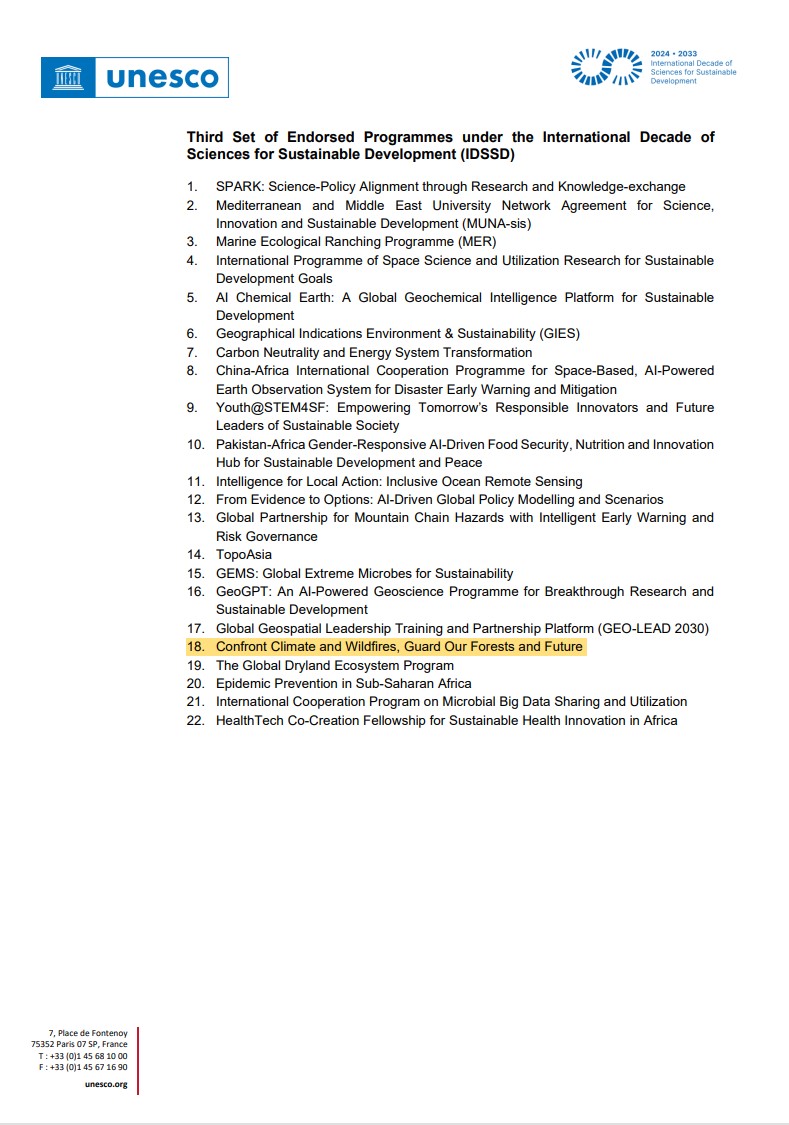
List of Programmes selected in this round of UNESCO’s “Science Decade”
Addressing common scientific challenges in the field of global fire safety, the programme builds on the National Key Research and Development Program of China for Young Scientists, “Research on Large-scale Wildland Fire Risk and Spread Prediction under Extreme Climate Conditions” (PI: Yu Wang). The programme brings together researchers from Imperial College London and Nanjing University, including Prof Guillermo Rein from Imperial College London. Their work examines the development and spread of large-scale forest fires under extreme climatic conditions, as well as ways to improve fire risk assessment and fire spread prediction. The findings are expected to support the protection of forest ecosystems, strengthen climate resilience and contribute to the achievement of the United Nations Sustainable Development Goals (SDGs).
The “Science Decade” was proclaimed by the United Nations General Assembly in August 2023 and is led by UNESCO. The initiative uses science to promote global collaboration and advance the Sustainable Development Goals. Under the initiative, activities are organised at three levels including Programme, Project and Activity. Programmes represent the highest level and focuses on long-term international scientific cooperation.
Programmes under the UN International Decade of Sciences for Sustainable Development
It is also worth noting that “Improving Fire Safety and Resilience in Informal Settlements for over One Billion People”, led by Prof Yu Wang and jointly proposed by the University of Science and Technology of China, the University of Edinburgh and the Central Police University, has also been selected as a project in the third round of the “Science Decade”. A total of 39 projects from around the world were selected in this round. Addressing the need to improve fire safety and resilience for more than one billion people living in informal settlements worldwide, the project seeks to develop scientific approaches to fire risk prevention and control in informal settlements through interdisciplinary and cross-regional international collaboration.
The selection of one global programme and one global project in the same round reflects USTC’s growing international influence in fire safety and its increasing capacity to lead global scientific collaboration. It also provides USTC with a broader international platform for further contributing to global sustainable development governance and advancing shared human safety.


